
The New Silk Road is Digital: Malaysia’s Role as a Cultural Hub in the RCEP Era
16 Nov.
Author: HUANG JIAJING
Editor:ZHANG YAO
For centuries, the Strait of Melaka has been the jugular vein of the global economy and a physical testament to the ancient Maritime Silk Road, where spices, tea and textiles flowed among different civilizations. However, during the 18th World Federation of Hainanese Associations (HNWF2025) from Nov. 14-16, 2025, visitors witnessed a profound shift in this historical narrative in the spacious hall of the Setia SPICE Convention Centre in Penang. The air was not filled with shipping lanes or cargo manifests, but with discussions about cloud computing, cross-border e-commerce algorithms and digital free trade zones.
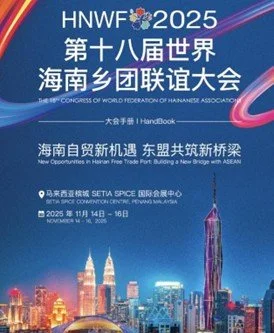
[Official promotional image of the 18th World Federation of HainaneseAssociations (HNWF2025)]
The most compelling piece of evidence for this paradigm shift was not found on the main stage, but in a strategic development that occurred concurrently in Kuala Lumpur: the official inauguration of the Hainan International Media Center’s (HIMC) ASEAN Liaison Center. This facility represents far more than a mere office; it is a physical node in a new, invisible network. While the Regional Comprehensive Economic Partnership (RCEP) has successfully lowered tariff barriers for physical goods, the summit in Penang revealed that the next frontier of integration is informational. For Southeast Asia, the establishment of the HIMC center signals that China’s engagement with Southeast Asia is evolving from hard infrastructure ( ports,railways,and bridges) to soft infrastructure(media, data, and digital connectivity). In this new architecture, Malaysia has been strategically selected not merely as a transit point, but as the primary anchor.
Under the framework of RCEP, the process of economic integration in the Asia-Pacific region has accelerated, but "cultural frictions" remain the biggest non-tariff barrier hindering genuine cooperation. Over the past few decades, Malaysia has been driving the economic development of Southeast Asia. Today, with the gradual formation of the "Digital Silk Road", Malaysia has become an important cultural hub. Unlike any other country in the region, Malaysia has a unique "trilingual advantage" (Malay, English, and Mandarin) and a profound cultural fluency, enabling it to interpret complex narratives. With the help of Malaysia, countries exchange not only goods, but also culture and understanding.
But with this huge opportunity comes a big question: Are we ready to lead, or will we just follow? With so much content flowing in from a superpower like China, there is a risk that Malaysia becomes just a passive audience. We might end up merely repeating their messages instead of sharing our own perspective. We have plenty of graduates who can write computer code, but do we have enough who can "decode" culture? If we don't start creating our own content, we risk becoming just a marketplace for data, rather than a partner with real value.
The solution is simple: We need to stop just watching and start creating. Li Chengchao, the deputy COO of the Hainan International Media Center, gave the perfect analogy during our interview. He explained that while China might provide the technology, the content must come from us. "We are building the digital highway," Li said, "but the cars driving on it— the stories and the culture— must be driven by Malaysians." Li emphasized that the new Liaison Center isn't a loudspeaker for China to shout at us, but a microphone for us to speak to the world. "We need local youth to tell the ASEAN story," he added. So, for students in media or business, the advice is clear: Don't look at these clan networks as old history. Look at them as your new platform. Use them to show the world what Malaysia has to offer.
In conclusion, the 18th World Hainan Entrepreneurs Summit in Penang was more than a gathering of clans; it was a preview of the new geopolitics of trust. The "Old Silk Road" was paved with stone and navigated by stars; the "New Silk Road" is paved with fiber optics and navigated by data. For Malaysia, this means that our value lies not only in our position on the map, but also in our culture and people. Young people in Malaysia should be aware that our traditions are not merely "old burdens". It is actually the best tool for our future.
We have the opportunity to become the cultural center of this region — we just need to be brave enough to log in and lead.