
What Kuala Lumpur’s Stranger Rides Pop-Up Reveals About Urban Cultural Logic
8 Jan.
Author:LIU YITING
Editor:WU WENYU
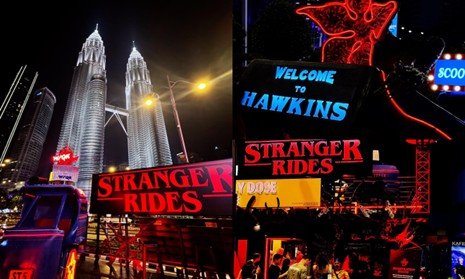
[ffline hype in Kuala Lumpur from Rednote, Nov 27–30]
As “Stranger Things” Season 5 kicks off its staggered release as the final season, bringing an end to this nearly decade-long global hit series, Netflix launched the officially licensed Stranger Rides pop-up experience in Kuala Lumpur a month early. The excitement there is understandable: official licensing, immersive installations, time-limited circulation and check off visual stops. It seems designed for face-to-face presence. This is not the spontaneous local fan event, but a globally synchronised promotional campaign. However, the real question may not be whether the pop-up was entertaining, but rather: when global IPs enter urban public spaces at their finale, is the city participating in the creation of shared memories, or is it merely being used as a venue for attention-grabbing?
In terms of experiential design, Stranger Rides emphasizes not plot completion or narrative extension, but making participation visible, recordable, and communicable. Local coverage mostly focuses on immersive installations, check off spots, time-limited circulations, and processes made interactive - having a seamless path in: enter, capture, and carry the content out. In a platform-driven communication environment, an experience’s worth frequently depends as much on “what I can present” as on “what I sensed”. Eventbrite's survey on millennial consumer behavior showed that more than 3 out of 4 millennials are spending on "experiences" more than "possessions". This preference makes "proof of presence" itself into a consumable souvenir.
Taking a broader view, the significance of the pop-up lies not just in the foot traffic it generates, but in how it integrates urban spaces into a larger chain of attention.In covering Netflix's promotional campaign for the final season of the series Stranger Things, Reuters reported that offline activations and merchandising efforts were used to keep the country's attention longer and help it stick. The inclusion of Kuala Lumpur in the global event itinerary on Netflix Tudum also indicates that such pop-ups are not locally spontaneous but part of a unified communication strategy. In other words, the city plays the role of a “converter” here: transforming the popularity of online entertainment into spatial experiences, and then channeling the offline-generated foot traffic, visuals, and conversations back online for further dissemination. Rather than being a backdrop for stories, the city itself is a medium amplifying, translating and disseminating the story.
The question then emerges: as a given city becomes more adept at staging these "orchestrated cultural moments", who is more visible, and who does not get seen? At the finale of global IPs, local creations rarely enjoy a closing episode’s spotlight. Foreign IPs come with their own budgets, narrative frameworks, and mature dissemination mechanisms, creating overwhelming visibility at their conclusion. In contrast, long-term local cultural projects are usually based on slower accumulation and more fragmentary resources and distribution channels to attract public attention. This is not a moral critique of "pop-ups" or "fan culture", but rather a reminder of a structural reality, namely that when the rules of attention are dominated by "communicability", local creativity is forced to compete under the same set of rules. And this set of rules does not necessarily have any pro-long-terminvestment characteristics.
There’s a clear rationale for introducing global IPs. These pop-ups have the benefit of boosting retail, catering, and nighttime economies in the short term, as well as giving the city a chance to become a part of the international cultural landscape. In its coverage of Stranger Rides, local media such as Malay Mail depicted it as if it were a form of festive urban: familiar neighbourhoods are temporarily altered, crowds and visuals highly concentrated within a short amount of time, creating an urban atmosphere of 'happening right now'. For many participants, it is not the right or wrong of the experience, but the fulfillment of immediate needs for emotional, social and participatory engagement.
Being seen is not the same thing as building cultural strength. The glow of a series finale will fade, the pop ups will be packed up and the buzz will recede. Yet the city still confronts the gradual, intricate work of cultural creation. The meaningful debate isn’t about letting global narratives in, but about what happens after the staging is cleared away: does the city have the means to continue to create its own cultural relevance? Are there places and mechanisms for the local creation to be noticed and joined and continued? Drawing shortterm buzz isn’t hard. The challenge lies in what stays when the buzz is gone.